
A USPTO Eligibility Framework Requirement: At Prong 1, Identify the Abstract Idea—and Keep It Consistent
Written by Ben Esplin
Last week, the USPTO eligibility framework for the Alice/Mayo test was compared with the Federal Circuit’s approach. Here, a narrower proposition is offered: a single concept is virtually required to be clearly identified as “the abstract idea” at the beginning of Step 2A, Prong 1, and used consistently throughout the remaining analysis.
This may seem like a straightforward principle, but direct and express opposition to this premise have motivated this short argument.
The MPEP’s instruction is pointed:
“Unless it is clear that a claim recites distinct exceptions, such as a law of nature and an abstract idea, care should be taken not to parse the claim into multiple exceptions, particularly in claims involving abstract ideas.”
That caution is followed by a direction that, “if possible,” the claim should be treated as containing a single judicial exception for Prong 2 and Step 2B. Claims commonly contain multiple different concepts that could be identified as abstract ideas at Prong 1 of the USPTO eligibility framework. But MPEP §2106.04, II.B states their limitations should, where possible, be considered together as a single abstract idea rather than analyzed individually. “Single” need not mean elementary: several constituent concepts may be encompassed by one identified idea. However, the compound concept must then be drug through the rest of the USPTO eligibility framework as a whole.
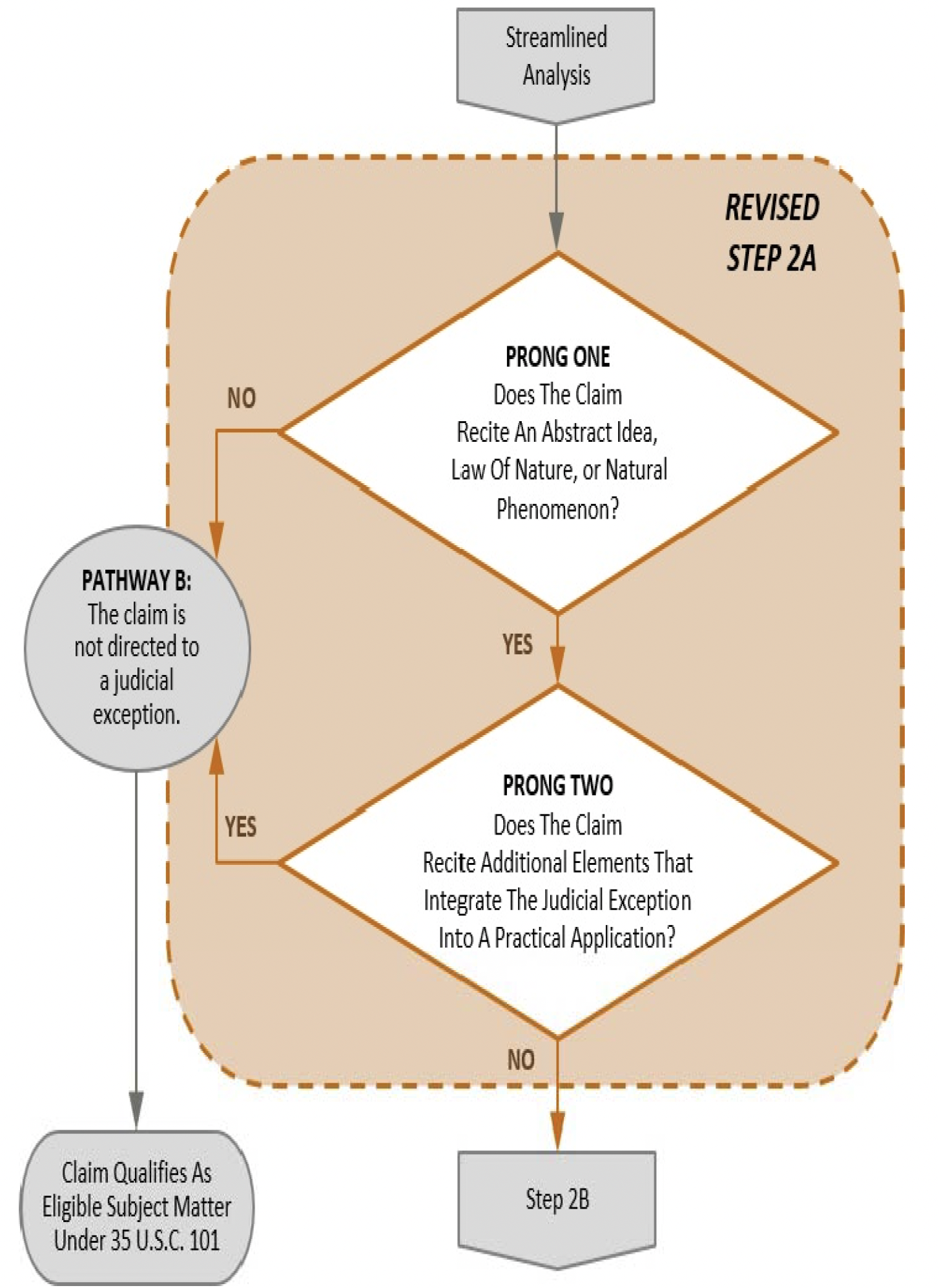
The accompanying flowchart from the MPEP reflects the same continuity. An exception is introduced in Prong 1 and carried into Prong 2 as “the judicial exception.” Both inquiries fall within Step 2A. The subject introduced in the first is the subject evaluated in the second—not an abstraction chosen anew when the next box is reached.
The rejection instructions reinforce that reading. The abstract idea is to be identified as recited in the claim, followed by an explanation of why “it” is abstract. The later inquiries expressly concern “the identified judicial exception.” Identification, explanation, and subsequent evaluation are textually connected. MPEP §2106.07(a).
Read together, these directions require a clear identification from the outset—not merely an idea settled upon when Prong 2 is reached. An explanation of why a concept is abstract must already have an identifiable subject. A high-level characterization or specified claim language may supply that identification, provided what is being treated as the abstract idea is made clear. Its identity should not have to be reconstructed from descriptions scattered throughout the rejection.
Consider a rejection in which the abstract idea is initially identified as comparing two values, but the ensuing explanation (whether it is alternative or additive) concerns managing an entire transaction. Those descriptions may encompass materially different subject matter. An explanation of why the comparison is abstract does not, without more, establish why the transaction is abstract. Nor are the two made interchangeable simply because both are called “the abstract idea.”
The consequences extend beyond Prong 1. If the exception is expanded from the comparison to the entire transaction, the distinction between the exception and the additional elements may change as well. A practical application of one concept cannot simply be treated as a practical application of another. The same difficulty arises when significantly more than the exception is evaluated. Whole-claim consideration does not eliminate the need to know which exception is being considered.
Preferably, a consistent term or phrase would be used throughout. Identical wording is unnecessary, but continuity of meaning is not. What is identified and explained as abstract in Prong 1 must remain the subject of the practical-application and significantly-more inquiries. This is not merely a preference for clearer writing. The prescribed analysis depends on keeping its subject consistent.
As I mentioned, I have received direct and opposing feedback on this requirement. If you have an opposing view, please let us (or at least me) know.