
The Company As “Trade Secret Office”
Written by Ben Esplin
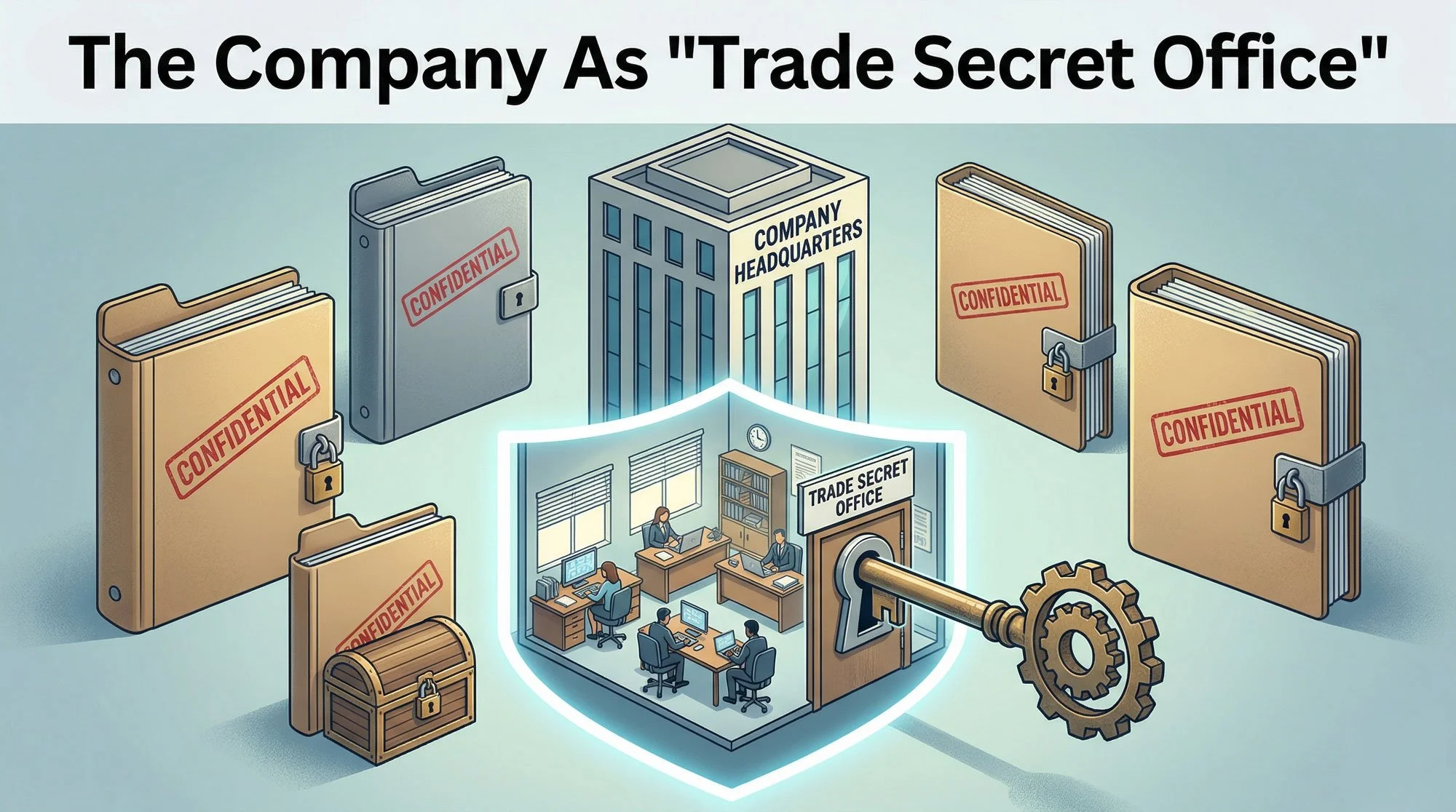
For companies with valuable intellectual property, a fundamental distinction exists in the legal and psychological approach to patents versus trade secrets. Intrinsic to the patent process is a requirement of validation by a distant examiner. Trade secrets operate on the principle that the power to create legal certainty resides entirely within the enterprise. In the realm of trade secrets, the intellectual property owner functions as its own patent office. This is not a mere metaphor but a reflection of the legal framework surrounding the protection of proprietary information. Under the law, trade secret status is not granted by a third party; it is established through the owner’s own “reasonable measures” to maintain secrecy. While external agencies may struggle with immense backlogs and shifting administrative policies, a company with a robust trade secret program does not wait in line for validation. By identifying an asset, evaluating its competitive value, and implementing protective protocols, a company effectively grants itself a protected legal status that is immediate and durable.
Since the process of identification and evaluation happens entirely within the corporate structure, the uncertainty of an external gatekeeper is eliminated. In a traditional patent office, an examiner might reject a claim due to a misunderstanding of the underlying technology or a change in agency guidelines. Within an internal framework, the company sets the standards. The business determines which algorithms, manufacturing processes, or strategic datasets, for example, possess the independent economic value required for protection. The company serves as the internal examiner, deciding what constitutes a “reasonable measure” based on its specific technical and financial environment. This internal authority creates a unique form of intellectual property certainty. When a company treats its innovation pipeline as a self-regulatory system, it moves from being a passive recipient of government-granted rights to becoming an active architect of its own market value. The administrative tasks of cataloging and evaluating intellectual property serve as the internal examination that proves an asset’s existence long before it is tested by a competitor or a court. In an environment where external intellectual property policies may fluctuate, the most reliable authority for securing innovation is the one managed within the company’s own walls.
For a quick primer on the basics of trademark law, policy, and/or strategy, please see my previous writings here, here, and here.